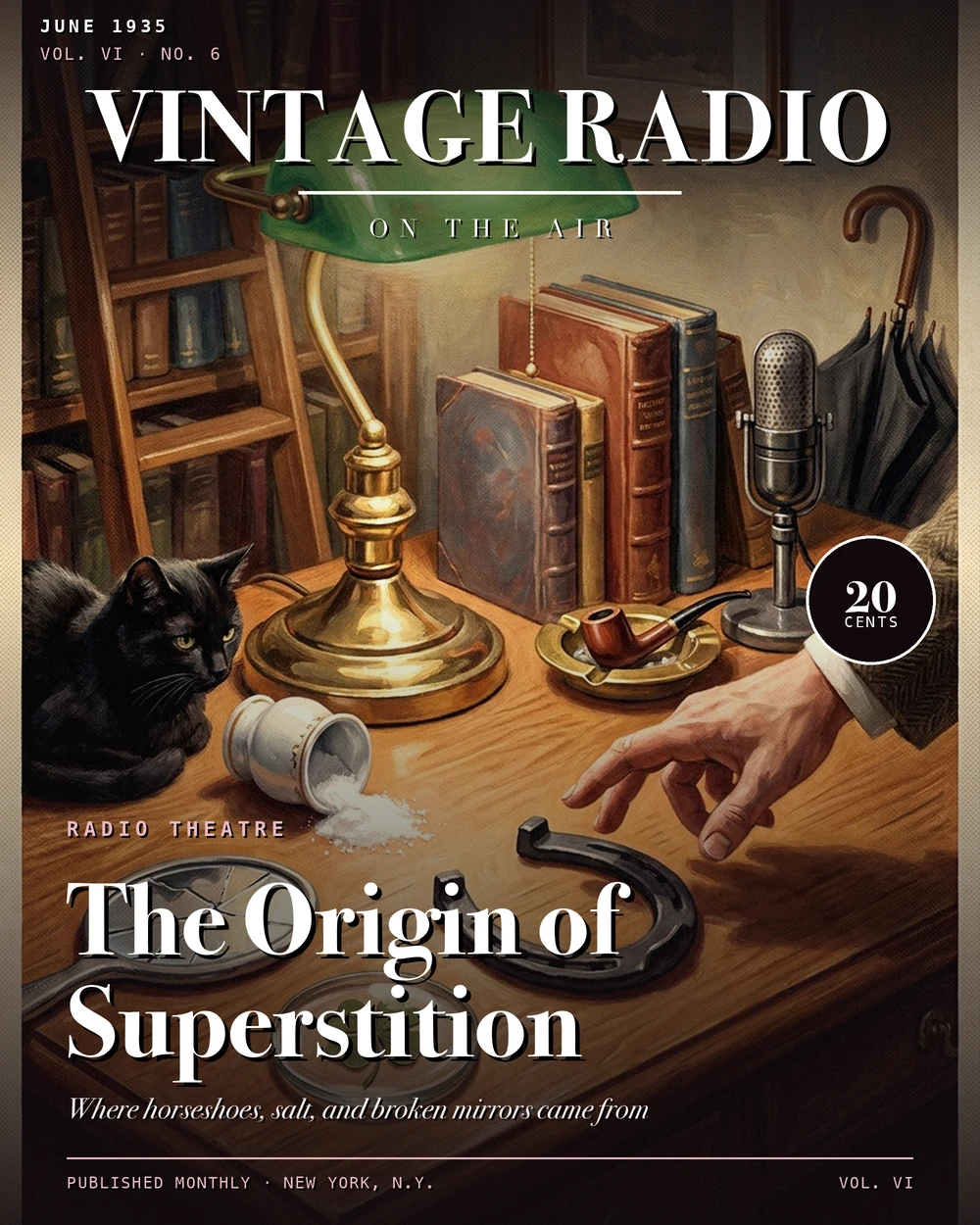
The Origin of Superstition
How It Was Built
The Origin of Superstition ran entirely within 1935, a short-form syndicated drama produced and distributed by Transco — the Transcription Company of America, based in Hollywood. Transco was a serious player in syndicated radio content during the 1930s, and the same outfit would record The Cinnamon Bear two years later in the same Hollywood studio. The connection matters: The Origin of Superstition drew on the same stable of performers Transco would later deploy on that more famous holiday series, and the production reflects the same approach to tight, polished studio work that Transco applied across its catalog.
Each episode ran about fourteen minutes, making it what the industry called a filler program — short enough to slot into a station's schedule wherever a gap needed filling, without requiring a network commitment. Thirty-nine episodes survive in known collections, adding up to just over nine hours of audio. That's a meaningful run for a show of this kind. Transco syndicated it to local and regional stations rather than placing it on a major network, which is why the show left little trace in the big national radio publications of the day. It does not appear in the major OTR reference works, and the available documentation comes primarily from archival episode records and catalog listings. A figure named Robert Farrell is credited in some archival sources in connection with the series, though whether he served as writer, producer, or announcer has not been established. The program also circulates in some collections under the alternate title Superstition on the Air.
The Format That Made It Work
The show used a tight, repeatable structure that suited both its short running time and its subject matter. Each episode opened in the present day, with two characters in conversation. One of them would invoke a familiar superstition — a black cat crossing a path, a hat left on a bed, the danger of sailing on a Friday. The other character would question it or push back, and that exchange would cue a dramatic flashback dramatizing the historical or legendary origin of the belief. Near the end of the episode, the action returned to the framing scene, and an announcer would close things out by noting that superstitions, origins notwithstanding, are ultimately without merit.
The on-air introduction made a pointed claim: that episodes were based on meticulous research, with only the characters' names changed for discretion, and that all other details were factually accurate. That framing gave the show a documentary quality even as it relied on dramatization and voice performance to carry the story. The irony, noted by radio historians, is that at least one episode — on the superstition of crossing one's fingers — leans heavily on clearly legendary and supernatural narrative elements. The gap between the show's stated commitment to accuracy and the content of that episode became something of an entertaining footnote to the series. Whether the writers were aware of it or simply didn't mind is not recorded.
The Cast
The performers Transco assembled were working radio actors who would go on to longer careers and more celebrated work. Verna Felton, Hanley Stafford, Gale Gordon, Howard McNear, and Barbara Jean Wong all appeared on The Origin of Superstition, and all five would return to Transco's studio two years later for The Cinnamon Bear. That overlap isn't coincidental — Transco relied on a core roster of Hollywood radio talent, and these five were among the reliable working actors the company called on repeatedly.
Gale Gordon would eventually become one of the most recognizable character actors in American broadcasting, with a long run alongside Lucille Ball. Howard McNear, decades later, played Floyd the barber on The Andy Griffith Show. In 1935 they were journeyman radio performers doing what journeyman radio performers did: moving from project to project, adapting to whatever format a producer handed them. Voice acting on The Origin of Superstition is described in available accounts as notably strong, with performers bringing depth and emotional range to roles that had to establish character quickly within a fourteen-minute running time. The dramatic flashback sequences demanded that kind of flexibility — actors had to shift between the conversational present-day framing scenes and the more heightened register of historical dramatization within the same episode.
What the Episodes Covered
The episode titles alone give a clear picture of the series' scope. The catalog includes episodes built around wishing on a new moon, wishing on a shooting star, blowing out birthday candles, throwing shoes, a howling dog, a four-leaf clover, bubbles in a teacup, a cap turned backwards, a hat on a bed, and the old wedding rhyme of something old and something new. There are also episodes on not turning back once you've set out on a journey, not sailing on a Friday, black cats crossing a path, and Friday the thirteenth — a sample episode that runs the standard fourteen minutes and is often cited as a representative example of the series.
The range of topics reflects the show's stated ambition to examine superstitious beliefs held across different societies and to trace how those beliefs evolved over time. Some superstitions addressed are personal omens, others are tied to navigation and travel, others to domestic life and courtship. The connecting thread is the show's consistent argument that superstitions arise from the human need to find explanations for the inexplicable — that people reach for patterns and causes when the world doesn't offer obvious ones. The scripts work that idea through anecdote and characterization rather than lecture, letting individual stories carry the weight.
Why It's Worth Knowing
The Origin of Superstition sits in a category of 1930s radio that rarely gets much attention: syndicated short-form drama built around a thematic concept rather than a recurring fictional cast. There was no hero to follow from week to week, no serial plot. What held the series together was the format — the same conversational structure, the same flashback device, the same closing moral — and the consistency of the production.
Because Transco distributed the show through syndication rather than placing it on a network, it bypassed the infrastructure that would have generated press coverage, Variety notices, and entries in the reference books. That explains why the major OTR reference authorities have nothing on it. The catalog of 39 episodes is what survives, and the episode record is what makes it documentable. For a program that never had a national sponsor or a prominent network time slot, 39 surviving episodes is a reasonably substantial record. The Transco connection — the same Hollywood studio, the same cast, the same production approach that would later produce The Cinnamon Bear — provides the clearest context for understanding what this series was and where it came from.